London is a city that refuses to sit still. It has forever been a busy bustling place, a great restless organism. It never ceases its endless invention. A shop vanishes, a cafe becomes a pub, a thirty-storey office block sprouts from a derelict yard, and by tomorrow even that may be gone. So much changes all of the time. Sometimes its nearly impossible to keep up with it all. None more so than the thriving Street Art which you can see around Shoreditch and London’s East End.
The walls themselves seem alive, as soon as a new picture is pasted, a piece of graffiti sprayed in a corner, a stencil or some astonishing painting is set on a wall, another artist comes along and throws something else up; a new vision, a new spray of colour. It’s always changing, always moving, always never the same. And that makes it so exciting. The place never sits still.

Not long ago I was commissioned to devise a walk on the theme of Street Art; a straightforward task, I imagined, a nice meander between coffee stalls, perhaps a chance to eat a spicy empanada or a kati roll, and check out some art. But before I knew it I’d gone down a very long rabbit hole, in fact a warren of tunnels, exploring the artists, their themes, codes, emblems and motivations. Days went by in this underworld of colour and style and very enjoyable it was too.
So as its cold and grey outside, London very much in its winter phase, I thought I’d share some nice bright summer photos of my favourite ones, pictures and artists that is, and I hope you enjoy them.

So what is Street Art? And where did this peculiar compulsion originate, the urge to make our presence seen? Where does it come from?
Well, of course, we’ve always made art. From the very beginning, long before writing, before even agriculture, we painted walls of caves that sheltered us. Our first homes, our first wallpaper. There, in those flickering fire-lit corners, hands were stencilled, herds thundered across stone, and constellations of dots recorded an early attempt to understand our place in the world. These first marks were not decorations, they were declarations: we are here. It was an expression of our environment and our presence within it; and the mystery that encompassed.
Later, much later, the walls of Pompei and Herculaneum, were covered in some of the earliest written graffiti. The walls positively teemed with messages. Cheerful, political, often crude: “Lucius was here”, “If you’re lazy and love to sleep, vote for Marcus Gaius”, “Apollinus defecated here”, “Marcellus loves Pratenistabut, but she doesn’t care for him”; fleeting scribbles, and in them we recognise ourselves: our humour, our vanity, our heartbreak.

Street Art as a form of recognisable artwork and commentary took shape much later, starting in 1970-80s, the image we are most familiar must be the New York City subways and trains, rolling galleries covered in graffiti, sprawling letters, tagging, turning entire carriages into murals. The Berlin Wall became another identifiable form of this art, of activism, protest; a battleground of slogans, stencils, symbols, each a small act of defiance against division and politics.

By the time of the 1990’s the movement had become something altogether different, it had become paradoxically trendy, fashionable, dare I say it collectable. Artists like Banksy, D*Face, and STIK became globally recognised artists, their work could be seen everywhere, be it New York, Cape Town, LA, Milan, Madrid and of course London. Their works migrated from alleyways to auction houses.
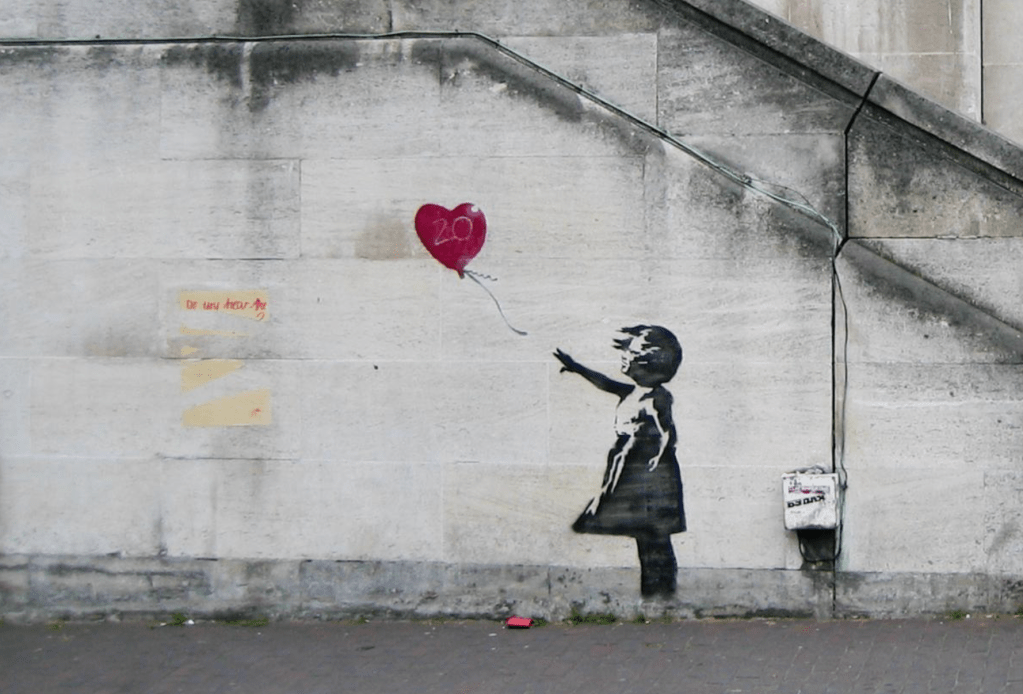
However they always remained true to their beliefs, these mischievous spirits, put their art here on the streets, because they had to be free, they had to connect to those who wouldn’t ordinarily be seen in a gallery. They were for the people, and always have been true to the spirit of this art. Even now, the authorities are more busy scrubbings walls, than ever before. Long may this last. Because Street Art is high end protest, high end social commentary. So lets take a look at some.
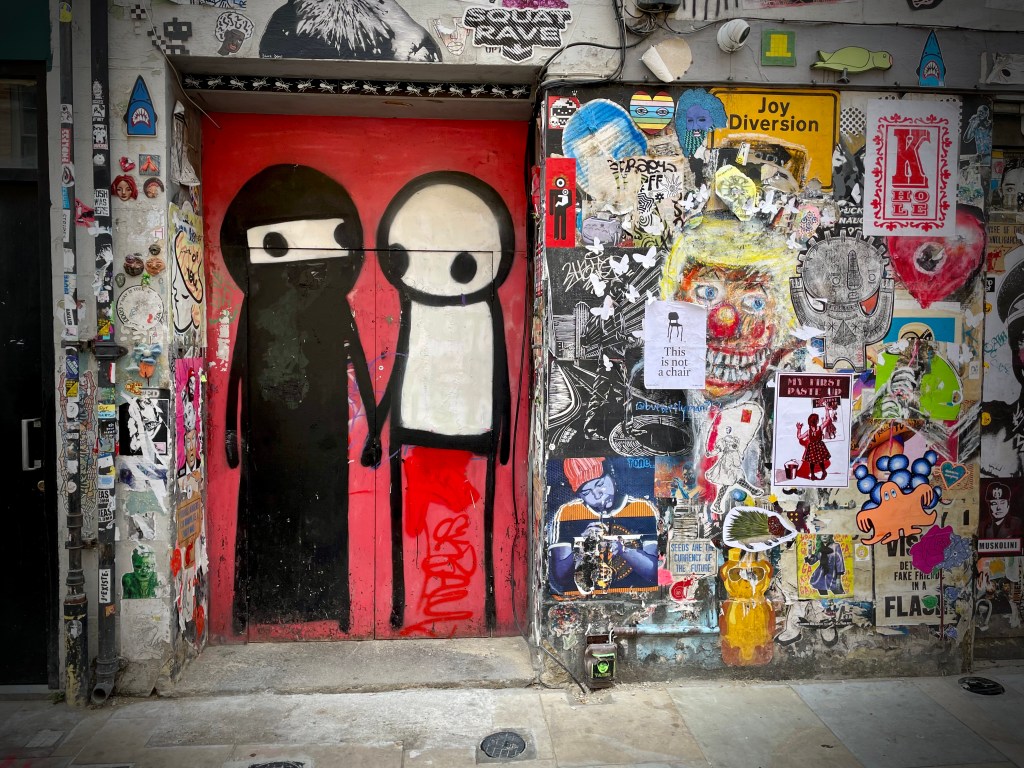
We have to start with my absolute favourite. “Holding Hands” by STIK. A pair of stick figures, STIK’s signature style, stand hand-in-hand, expressing unity, vulnerability, shared humanity. Though deceptively simple, the work carries a powerful emotional charge. STIK began creating street art in Hackney and Shoreditch in the early 2000s, treating walls as a means of public communication rather than mere decoration. He collaborates with local communities before painting, ensuring the work reflects their views. Through pieces like Holding Hands, STIK cuts through the noise, addresses themes of connection across cultural or personal divides, as well as broader social issues such as homelessness and gentrification.

This piece pays tribute to Keith Haring, the influential American artist whose bold imagery championed social causes in the 1980s, including AIDS awareness, gay rights, and anti-apartheid activism. The ring of dancing figures in his hair echoes Haring’s famous figure silhouettes, joyful, rhythmic forms that dance. Around them, layers of red, green, and yellow stencilled patterns create a clash of styles. This is by the collective known as Cartoonneros. The result is both a celebration of Haring’s legacy and a reinterpretation of his spirit of activism.

ALO is an Italian street artist known for a style he describes as Urban Expressionism, blending street art with elements of expressionism and folk art. Rather than spray paint, he works mostly with acrylics and oils, giving his pieces a distinctly hand-painted texture with visible brushstrokes and patterned details. This often takes him a while to create, so if you’re lucky, you might bump into him. His figures are characterised by flat, minimalist shapes, repeated vertical lines, and a quiet intensity. The solemn face and blue, tear-like eyes of this piece reflect the melancholic quality often present in his work. Its like they’re watching you as you pass.

This large-scale mural by London-based artist and community muralist Jim Vision, often described as a post-modern vandal, showcases his signature swirling colours and psychedelic textures. This image has a story which I think has something to do with the building which it is painted upon. This is a social housing area, and the people inside are often people overcoming addiction, so the woman enveloped in movement, suggesting emotional turbulence, has something to say. In her hand, she holds a balloon, 5, a symbol open to interpretation, perhaps hinting at the fragility of celebration or the fleeting nature of milestones. The painted phrase “Love wins if you try harder” emphasises this message.


This is by WILKO, I am pleased to say a friend of mine, WILKO’s work blends geometric forms with tribal-inspired motifs, it always reminds me a little of Braque and Picasso, he creates a striking balance of the primitive and the futuristic. These are paste-ups, layered over torn paper, which embraces the very nature of street art, always temporary, always in motion.

So I thought I’d on a doggy, because we all love, dogs. This is a striking review of an amazing area of art, come and have a look its amazing and ever changing. I hope you enjoyed it.


 The London Walker
Leave a comment