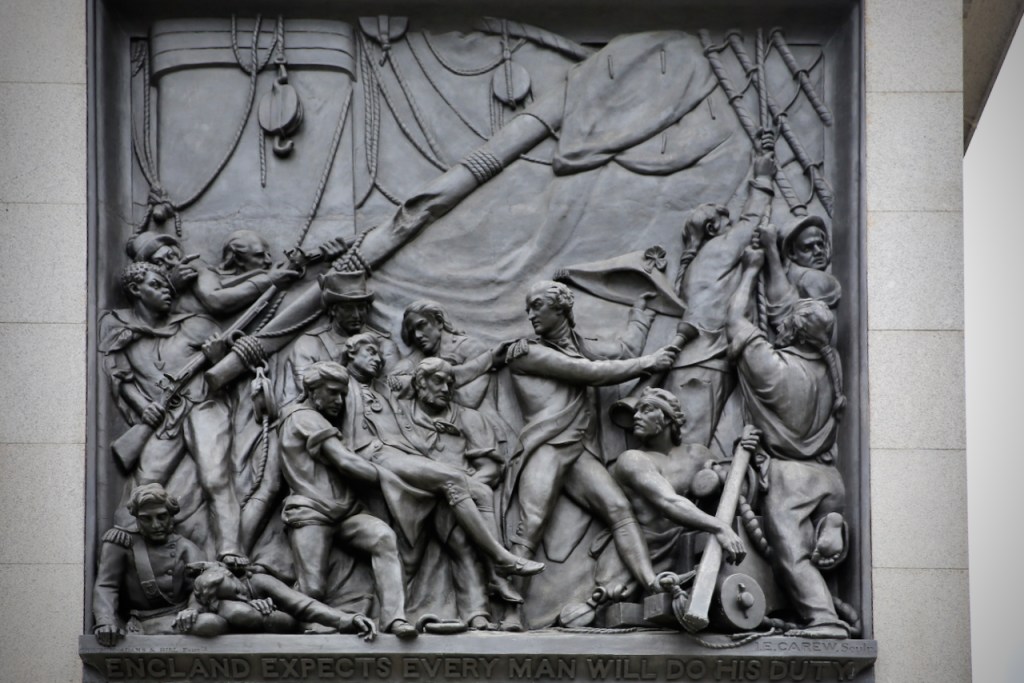
It’s October, and it’s Black History Month. So I thought I’d write a post looking at our multicultural heritage, celebrating some of our exceptional Black British family who have lived or contributed in some way to the country’s past and it’s future. And to start, suitably, is at one of the most famous monuments in England: Nelson’s Column in Trafalgar Square.
If ever you’re in Trafalgar Square and have a little time for a wander, head down to the famous Nelson’s column and take in the four remarkable bronze panels at the base. Cast from captured French cannons, each panel is sculpted by a different artist and depicts scenes from Admiral Horatio Nelson’s life, leading to the final climatic moment where the outnumbered British fleet win a decisive victory over a combined fleet of French and Spanish warships at the Battle of Trafalgar.
These panels are all interesting and wonderful works of art individually, but the one looking down Whitehall on the south face is the one you should focus your attention. Because in that incredible piece there is something both remarkable for the time of its creation and poignant due to its prominence: it tells, indeed celebrates an important aspect of our culture, our identity of being British, and being multiculturally British.
Not only that, the panel also contains a slightly fabulous mystery within it. What’s not to like?
This particular panel ‘The Death of Nelson at Trafalgar’, made by the notable Irish sculptor Edward Carew in 1850 is inscribed with Nelson’s famous signal to the fleet: “England expects every man to do his duty”. The relief depicts the moment where the British admiral is mortally struck by a snipers bullet at the high point of the Battle of Trafalgar. The officers and men are seen crowding around Nelson, helping him from the deck, still thick in the melee and violence of the battle. And what is striking to me, and glorious to see, is the inclusion of a black British sailor. He stands framing the left corner holding a loaded brown bess flintlock musket. It looks like he and the sailors behind him are searching out the French sniper who had fired the mortal shot which had hit Nelson.

Its a remarkable image. We have to consider that at this time imagery depicting people of race had seemingly always been through a negative prism. Either quintessentially exotic, almost perverse, to the callous and unfeeling, the shackled, the enslaved.
So this is an extraordinary piece of art considering the time it was made, and also in consideration of what it stands for, one of the most enigmatic statements of English heroism and sacrifice. It is a positive display of selfless courage, and here they are, British heroes, standing together amidst the smoke and chaos of a Napoleonic naval battle. His presence in the relief underscores the diverse makeup of the Royal Navy during Nelson’s time. This representation is significant to me as it highlights the often-overlooked presence and contributions of black sailors in the Royal Navy during the 18th and 19th centuries, as well as an increasingly diverse population countrywide at the time.
But the big question has always been, who is he?
The identity of the black sailor is not definitively known. His inclusion is widely seen as a symbolic representation rather than a portrayal of a specific individual. But its hard to not want to know, and many people have suggested the sailor is one George Ryan who joined the Royal Navy in West Africa and was serving aboard HMS Victory at the time of Trafalgar. We understand he bore a likeness to the figure, but one can never be sure. Alongside him that day we can tell from the records were other black sailors – we have their names, Jonathan Hardy, 25, an ordinary seaman, John Thomas, 23, a Jamaican, John Francois, 32, an ordinary seaman, to name a few. George Ryan is recorded as being 24. Records exist that show Ryan remained in the Royal Navy until 1813 when he was injured and honourably discharged at the age of 32 with a full pension. From this point on he fades into history.

Records from the period highlight the remarkable diversity within the Royal Navy. At the time of the Battle of Trafalgar, HMS Victory’s crew, the one we see depicted in this panel and the painting above, included nine West Indian sailors and one African. There were also sailors from Brazil, Russia, India, the Channel Islands, Switzerland, Portugual, Denmark, Norway, Germany, France, Italy, Malta, Sweden, Holland, America, Ireland as well as from Britain serving aboard. That’s already an incredibly diverse crew for one ship, the main ship of the line. In fact there is a record of the Muster Roll for HMS Victory before the battle, its worth looking at, click on the word link to see, its marvellous.
Even though the specific identity of the sailor is unknown, his presence on such a prominent monument symbolizes the inclusive nature of the British Navy and honors the contributions of all sailors, regardless of race. It also helped cement a greater appreciation of a wider more inclusive society in this country. Long may that strengthen, and last.
 The London Walker
Leave a comment