In the heart of Clerkenwell lies a thoroughfare steeped in history and change: Britton Street. What began as an unassuming stretch of land, occupied by gardens and modest dwellings, evolved into a bustling urban artery, bearing witness to the ebb and flow of time and people.
Britton Street can be traced back to the early 18th century, a time when London was undergoing rapid expansion and urbanization. Between 1718 and 1724, the once serene green landscape of gardens and fields hereabouts, gave way to what was then known as Red Lion Street. Its name derived from a prominent tavern situated at its upper end, where it intersected with the lively hub of Clerkenwell Green.
In 1937 the street underwent a transformation, not in its physical form, but in its name. The decision to rename Red Lion Street to Britton Street was a tribute to the legacy of John Britton, an eminent antiquary with deep roots in the area.
Throughout his life, Britton was a prolific writer and publisher, producing numerous works on subjects ranging from architecture and archaeology to literature and topography. He was particularly interested in documenting and preserving the architectural heritage of Britain, contributing significantly to the burgeoning field of antiquarianism and founded the British Archaeological Association.
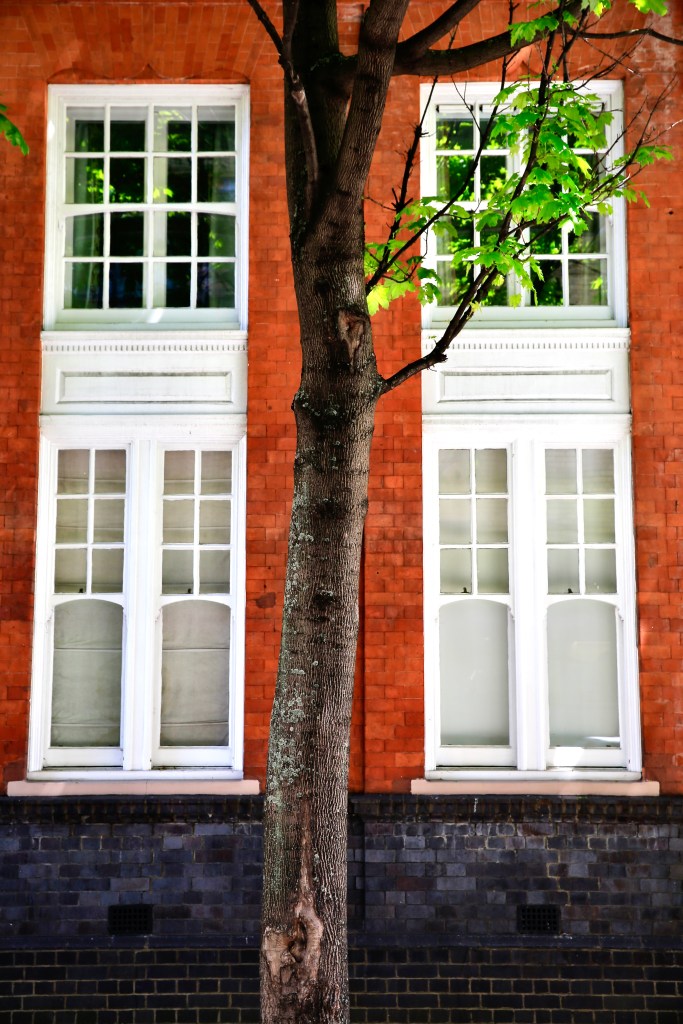
At the top is a beautiful line of maples, all coming into early leaf and they looked too gorgeous not to compose a shot with the brickwork behind.
 The London Walker
Leave a comment