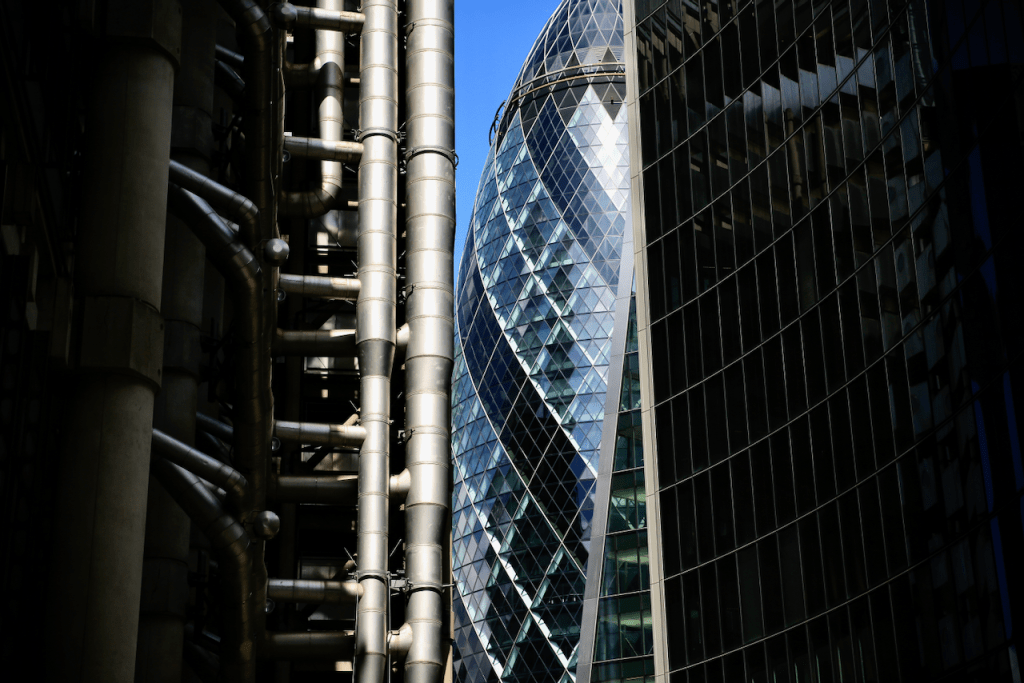
One of the stand out great pieces of modern London architecture, at times in danger of disappearing completely from view with all the new giant edifices rising around her, is the Gherkin, 30 St Mary Axe in the heart of London’s financial district.
Originally titled Swiss-Re the building quickly took the colloquial name given to it by Londoners as the Gherkin, which is much better than say the cucumber, or other more uncouth observations. The site originally contained the grand old building of the Baltic Exchange, a market for maritime insurance, but the building suffered extensive damage following a bombing during the Troubles in 1992.
Originally, the plan was to restore the damage but this was deemed unfeasible. After exploring various options, architect Norman Foster and his firm, Foster + Partners, were chosen for their innovative modern design. Foster, who has left a quite significant mark in architecture with his impressive domed roof of the Reichstag and reimagining of Wembley Stadium, drew inspiration from American designer Richard Buckminster Fuller, known for his use of lattice shell structures. A lot of modern architecture seems to enjoy putting the interior, the mechanics of the building, onto the exterior, and the Gherkin with its steel and glass framing seems to follow this principle in a beautiful fashion. In 2004, Foster won the prestigious Stirling Prize from the Royal Institute of British Architects.
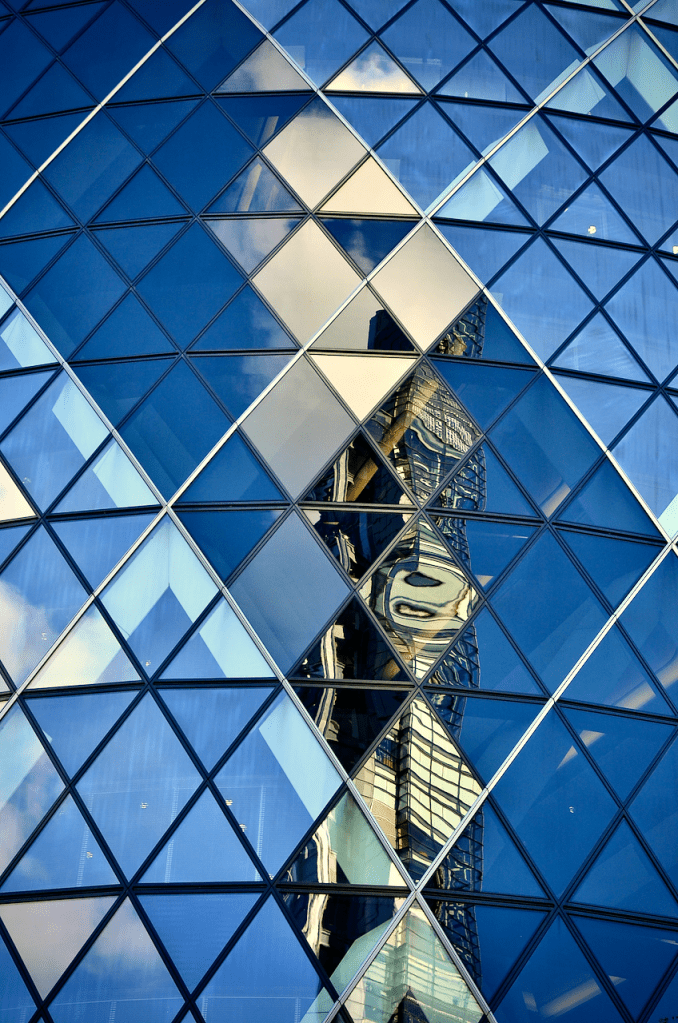
The Gherkin is a ground breaking piece of modern design. It uses only half the energy of similar sized buildings. Its innovative spiral shaped floor plan, featuring gaps between each floor, facilitates natural ventilation and light. The building’s exterior is a framework lattice of steel and glass diamonds making its distinctive pattern. With a total of forty-one floors, the structure offers incredible panoramic views and contains a restaurant and private dining rooms at the top. The Gherkin, for a fun and strange fact, has eighteen separate lifts.
At a 180 metres the Gherkin was the first building in the Square Mile to break the 200-metre barrier since Tower 42 the NatWest Tower was completed in 1981.
I’ve always been intrigued by the name of the street where the Gherkin is located. How did the street end up with the unusual name St Mary Axe? The story is stranger than fiction.The street has been around since possibly before the Norman Conquest, stretching from Houndsditch in the north to Leadenhall Street in the south. Its name comes from the church that used to stand here from 1230 to 1561 when it was demolished during the time of Elizabeth I.
The church was named after its claim to have one of the three axes used by henchmen of Attila the Hun to behead 11,000 virgins who were said to have accompanied St Ursula on a mission to convert pagans in 5th century Europe.
It’s said that Ursula a princess from southwest England sailed to join her husband the governor of Armorica in north west France. En route she and the 11,000 handmaidens that accompanied her, which would have made it rather complicated organising accommodation, decided to take a pan European pilgrimage. Outside Cologne, Ursula and her companions were captured by the Huns. Every single one of the 11,000 virgins was beheaded, while Ursula was shot with an arrow by the leader. One of the axes used by the Huns to execute the virgins, considered a holy relic, was kept in the church and hence the strange name St Mary Axe.
During construction archaeologists uncovered the body of a teenage girl buried here during the Roman occupation of the city. The girl lived between 350 and 400 AD and was between 13 and 17 years old. Her burial is something of a mystery as no other graves were found nearby.
Her remains were kept for safety at the Museum of London whilst work was completed and was reburied on site, very close to the original spot, shortly after work was finished. The funeral service combined a church service at St Botolph’s Aldgate with Roman funeral music and rites.
Her tomb is inscribed: To the spirits of the dead, the unknown young girl from Roman London, lies buried here.
 The London Walker
Leave a comment